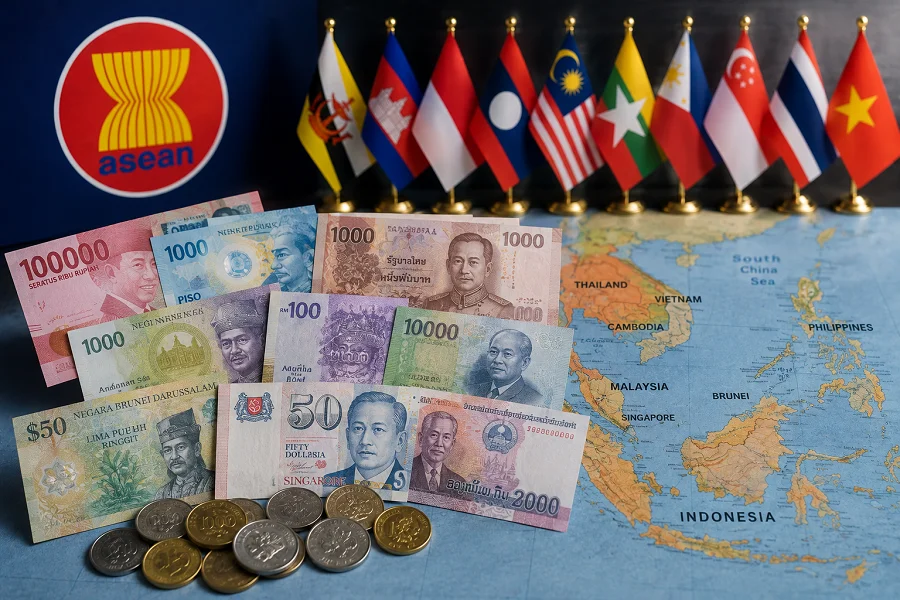
Planning a casino-focused trip through Southeast Asia sounds simple on a map: Singapore, Malaysia, the Philippines and Cambodia are all within a few hours’ flight of each other, and a determined traveller could realistically hit several major casino destinations in a single fortnight. What the map does not show is the currency headache waiting on the other side of each border. Unlike a eurozone road trip or a tour through the United States, where the same notes work everywhere, a multi-country ASEAN casino trip means navigating four or five entirely different currencies, each with its own quirks, denominations and casino-specific conventions. This guide covers exactly what casino travellers need to know before island and country hopping across the region.
Why ASEAN’s currency situation is genuinely more complex than most regions
Southeast Asia’s diversity is part of its appeal, but it creates a genuine practical headache that travellers to more currency-unified regions rarely have to think about. Singapore uses the Singapore dollar, Malaysia the ringgit, the Philippines the peso, and Cambodia operates on a dual system of riel and US dollars used interchangeably. A traveller moving between Marina Bay Sands, Genting Highlands, Manila’s Entertainment City and Phnom Penh’s NagaWorld within a single trip is, in practical terms, managing four separate currency systems, each requiring its own small mental recalibration of what a reasonable bet or tip actually looks like.
Singapore: the straightforward end of the spectrum
Singapore is genuinely the easiest currency environment in the region for casino travellers, with a highly developed economy where cards are widely accepted and ATM withdrawals in Singapore dollars are simple and reliable. The currency’s relatively high value compared to some regional neighbours means travellers need to recalibrate their sense of what a “normal” bet size looks like, a coffee in Singapore can cost noticeably more in raw currency units than the same coffee in Kuala Lumpur, and the same recalibration applies directly to casino minimum bets and chip denominations at Marina Bay Sands or Resorts World Sentosa.
Malaysia: ringgit only, with a skimming risk to watch
Malaysia operates strictly on the ringgit, and unlike some of its neighbours, US dollars are rarely accepted outside airports, meaning travellers heading to Resorts World Genting genuinely need local currency in hand rather than assuming dollars will smooth things over. A practical warning worth taking seriously: ATM card skimming is a recognised problem in Malaysia, so shielding your PIN entry and checking a machine’s card slot before using it is worth the extra few seconds, particularly for travellers who plan to make several withdrawals during a casino-focused stay.
The Philippines: peso-based, with pockets of dollar tolerance
The Philippine peso is the standard currency across the country’s Entertainment City casinos and the wider PAGCOR-operated network, though US dollars see some acceptance in specifically tourist-oriented areas. This partial dollar tolerance can create a false sense of security for travellers assuming they can rely on dollars throughout their stay, when in practice most casino floor transactions, food and incidental spending will require peso in hand.
Cambodia: the dual-currency exception
Cambodia stands apart from its neighbours by operating a genuine dual-currency system, where the US dollar functions as the primary currency in tourist-facing transactions, including much of NagaWorld’s operations, while the Cambodian riel is reserved mainly for small change and local transactions. This makes Cambodia, somewhat counterintuitively, one of the more currency-friendly destinations for casino travellers who already hold US dollars, though it is worth noting that Cambodian riel, like the Vietnamese dong, Lao kip and Myanmar kyat, is effectively worthless once you leave the country, so it is not worth stockpiling any more of it than you plan to spend locally.
The practical rule that saves the most money
Across every currency in the region, the same practical advice holds: exchange only small amounts before arrival, enough to cover immediate needs like transport and a first meal, and rely on ATM withdrawals or bank exchanges once you have landed rather than converting large sums in advance at unfavourable rates. Airport exchange counters and hotel front desks consistently offer the least favourable rates in the region, and it is worth comparing rates at a couple of licensed exchange counters or simply withdrawing directly from an ATM, which usually offers a genuinely competitive rate once any flat withdrawal fee is accounted for.
Card acceptance varies more than travellers expect
Major casino resorts across Singapore, Malaysia and the Philippines generally accept international cards without issue for hotel bills and larger purchases, but cash remains essential for local transport, smaller vendors and, in many venues, the casino floor itself, where minimum table stakes and chip purchases are still frequently cash-based transactions. Carrying a sensible mix of local cash and a card with genuinely low foreign transaction fees avoids both the inconvenience of running short on cash mid-session and the poor exchange rates that come with relying entirely on card payments converted at whatever rate your home bank happens to apply.
Building currency planning into a broader ASEAN itinerary
Currency logistics are just one part of planning a multi-country casino trip properly, and they sit alongside the broader cultural and practical planning that makes a Southeast Asian trip genuinely enjoyable rather than simply a string of casino floors. Resources covering the full breadth of Asean tourism across the region help travellers build an itinerary that accounts for these currency transitions alongside the cultural sites, food and local experiences that make the trip worthwhile beyond the tables themselves.
Bringing the region’s variety home between trips
For travellers who want to enjoy a similarly wide variety of table games and slots between countries, or simply cannot make it to the region right away, online casino platforms sidestep the entire currency puzzle by handling everything in a single, familiar account currency. An online casino such as beon bet lets players enjoy a genuinely broad range of games without the mental arithmetic of converting between ringgit, peso and Singapore dollars mid-session, a genuinely practical advantage while planning the logistics of an actual regional trip.
Budgeting across multiple currencies without losing track
The single biggest risk with a multi-currency casino trip is losing track of actual spending as denominations shift from country to country, since a large-sounding number in Cambodian riel or Vietnamese dong can obscure how much you are genuinely spending in familiar terms. Converting your planned casino budget into your home currency mentally before each session, rather than only thinking in local denominations, keeps your actual spending honest regardless of which country’s currency is currently in your wallet.
Responsible gaming while currency hopping
The unfamiliarity of foreign denominations can make it genuinely harder to gauge real spending while travelling, which makes setting firm limits before each casino session even more important than it would be at home. Decide your budget in your home currency, convert it clearly to local currency before you sit down to play, and treat that figure as a fixed ceiling regardless of how the local numbers look on the table. If gambling ever starts to feel difficult to control, whether at home or while travelling, free and confidential support is available through Gambling Therapy, which offers international, multilingual support for anyone with concerns about their own gambling or that of someone close to them.
Conclusion
A casino-focused trip through Southeast Asia offers genuine variety, but the region’s patchwork of currencies, from Singapore’s straightforward dollar to Cambodia’s dual riel-and-dollar system, demands more careful financial planning than a similar trip within a single-currency region would. Understanding each country’s specific quirks, Malaysia’s skimming risk, Cambodia’s worthless-abroad riel, the Philippines’ partial dollar tolerance, before you travel turns a potentially confusing currency scramble into a manageable, even interesting, part of exploring one of the world’s most currency-diverse casino regions.